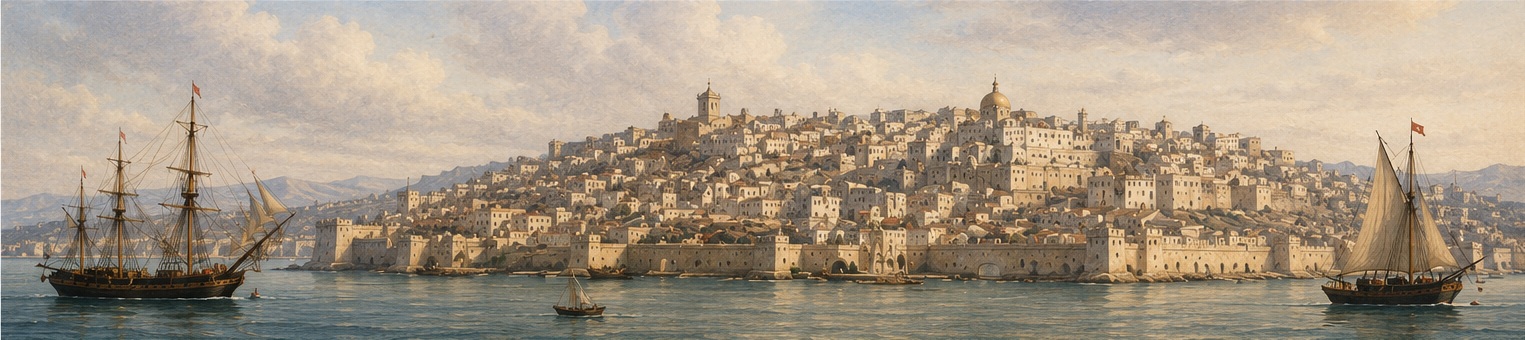
By the late eighteenth century the Regency of Algiers was no longer a simple Ottoman province administered from Istanbul. Its Dey was chosen in Algiers, its treaties were signed in Algiers, and its navy and treasury answered to the government of the city.
The formal connection with the Ottoman Empire remained part of the Regency’s political identity. Yet the effective authority exercised from the imperial centre had become limited. Hassan III Pacha governed within a system that had already developed substantial practical independence.
Historical Evolution
The political structure of Algiers had changed over two centuries. In the sixteenth century the city had been governed by beylerbeys appointed by the Ottoman Sultan. Later a dual system existed in which a Dey chosen locally shared formal authority with a Pasha sent from Istanbul.
After 1710 the Dey also assumed the title of Pasha. Istanbul ceased to send governors. From that point the ruler of Algiers was elected by the local political elite—primarily the Divan and the Odjak—and confirmed, rather than appointed, by the Porte.
This evolution produced a distinctive political order: a military republic that recognised the Sultan as nominal sovereign while conducting its own administration and foreign policy.
Institutions of the Regency
At the centre stood the Dey, assisted by a small group of senior ministers: the Khaznadji (treasurer and chief minister), the Wakil al-Kharadj (foreign and maritime affairs), the Agha of the Arabs, and others. The Divan served as a council of notables. The Odjak—the corps of Janissaries—remained a powerful force whose support was essential.
Beyond the capital, the three provincial beyliks—Oran in the west, Titteri in the centre, and Constantine in the east— enjoyed considerable local autonomy, provided they remitted the required taxes and maintained order.
This structure allowed the Regency to function as a coherent state while remaining formally within the Ottoman world.
Practical Sovereignty
The most striking evidence of autonomy lay in foreign relations. The Regency concluded treaties directly with European powers. It regulated the corso, collected customs duties, and received foreign consuls as representatives of an independent government.
Under Hassan Pacha this pattern continued without interruption. The recovery of Oran from Spain, the treaty with the United States, and ongoing relations with France, Britain, and other Mediterranean states were conducted by the government of Algiers.
The United States negotiated with Hassan Pasha, his Divan, and the subjects of Algiers—not with Istanbul.
Such direct diplomacy was the clearest demonstration that the Regency acted as a sovereign power in the Mediterranean.
The Ottoman Connection
The link with the Ottoman Empire was never entirely erased. The Friday sermon continued to be pronounced in the name of the Sultan. Each new Dey received the traditional symbols of investiture from Istanbul. Occasional gifts and formal correspondence maintained the relationship.
Yet these were largely symbolic and religious ties. They did not translate into day-to-day administrative control. The Sultan was acknowledged as caliph and distant overlord; the government of Algiers remained in Algiers.
A Mature Autonomy
Hassan III Pacha ruled during a mature phase of this system. The Regency possessed its own institutions, its own diplomatic personality, and its own capacity to pursue territorial and commercial interests.
The Ottoman framework still provided a measure of legitimacy and a connection to the wider Islamic world. But the everyday reality of power—the choice of rulers, the conduct of foreign policy, and the administration of the city and its provinces— belonged to Algiers.
Understanding this balance is essential to understanding the reign of Hassan Pacha and the political character of the Regency in its final decades.
Sources
- A History of Algeria, Cambridge University Press: analysis of the Regency’s political evolution and autonomy.
- Contemporary European diplomatic reports on the government of Algiers in the late eighteenth century.
- Studies of the relationship between the Regency and the Sublime Porte after 1710.
- Documentary evidence of treaties concluded directly by the Deys of Algiers.