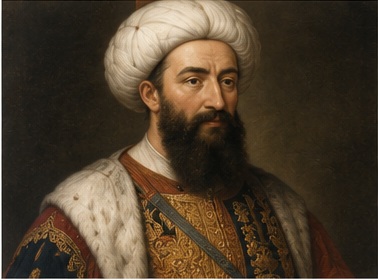
In July 1791, Sidi Hassan became Dey of Algiers, taking the name Hassan III Pacha. He inherited a political system unlike the centralized monarchies of contemporary Europe. The Regency of Algiers governed itself through its own institutions, maintained its own army and navy, negotiated with foreign powers, and selected its Dey.
Its relationship with the Ottoman Empire remained part of its political identity, but by the eighteenth century the authority exercised from Istanbul over the affairs of Algiers had become increasingly limited. The Deys governed with considerable autonomy, particularly in administration and foreign relations.
Before the Deylik
Hassan had already risen to an important position before becoming Dey.
During the long reign of Muhammad Ben Othman Pacha, Hassan served in senior administrative and diplomatic offices. He is associated with the position of Wakil al-Kharadj, through which the Regency conducted important aspects of its relations with foreign powers, and later became Khaznadji, one of the most senior officials of the government.
Contemporary American diplomatic correspondence from the early 1790s also refers to him as the former hasnagi—the chief minister or treasurer—before his accession.
This earlier career is important. Hassan did not arrive at the head of the Regency as an outsider to government. He had already spent years within the political and diplomatic machinery of Algiers.
He knew the Divan. He knew the officials who surrounded the Dey. And, perhaps most importantly, he knew the foreign representatives with whom Algiers dealt.
The Accession of Hassan III Pacha
Muhammad Ben Othman died on 12 July 1791. Hassan succeeded him as Dey, beginning a reign that would last until 1798.
His accession came at a moment of considerable activity.
Algiers was dealing directly with European states over questions of peace, commerce, maritime security, and territory. Spain remained an important power in the western Mediterranean, while the Regency's relations with other European states were governed through treaties and negotiated agreements.
The political world Hassan inherited was therefore not simply provincial. Algiers operated as a Mediterranean power with its own diplomatic interests.
A Dey in an Autonomous Regency
The political position of the Dey is essential to understanding Hassan's reign.
The Dey was chosen within the political structure of Algiers and governed with the assistance of the Divan and other institutions of the Regency. Although the Ottoman Sultan remained the nominal sovereign and the connection with Istanbul was never entirely erased, the effective autonomy of Algiers had become pronounced.
This distinction matters.
Hassan was not simply an Ottoman governor administering a province according to orders from Istanbul. The Regency conducted its own diplomacy and concluded treaties directly with European powers. Its government possessed the practical freedom to pursue its own interests, even while maintaining a formal relationship with the Ottoman world.
By Hassan's time, this autonomy was an established feature of Algiers' political life.
Diplomacy and the Mediterranean
Hassan's earlier career prepared him particularly well for this environment.
His reign was marked by continuing diplomatic activity with European powers. The Regency negotiated from a position shaped by its maritime strength, its strategic location, and its ability to regulate access to its ports and waters.
The relationship with Spain was especially significant. During the early years of Hassan's rule, negotiations accompanied the transfer of Oran and Mers el-Kébir to the Regency after the Spanish withdrawal.
The episode illustrates the character of Algerian diplomacy at the time: territorial questions, commerce, military power, and treaty-making were closely connected.
Hassan's diplomacy also extended beyond the established European powers.
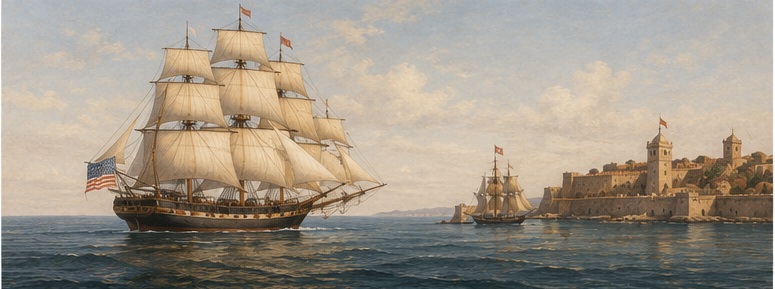
In 1795, the Regency concluded its Treaty of Peace and Friendship with the United States. The agreement was made between George Washington and Hassan Pasha, together with the Divan and subjects of Algiers. The original Ottoman Turkish document bears Hassan Pasha's tughra and seal.
The treaty is one of the clearest surviving documents illustrating the international position of Hassan's Algiers.
The United States did not negotiate with Istanbul for the treaty. It negotiated with Hassan Pasha, his Divan, and the Regency of Algiers.
That distinction speaks volumes about the practical sovereignty exercised by the Regency.
A Ruler Remembered in Stone
Hassan's reign also left a physical mark on Algiers.
Among the buildings associated with him is Dar Hassan Pacha, constructed at the beginning of his reign and situated within the historic urban fabric of the Casbah. The palace would later undergo substantial changes during the French period, but its name preserves the memory of the Dey who commissioned it.
Other works associated with Hassan's period include interventions around the Ketchaoua Mosque and other parts of the city.
For Hassan, architecture was not merely private display. The palaces and public works of the Deys formed part of the political landscape of the Regency—the visible expression of a government that ruled Algiers in its own name.
The Final Years
Hassan Pacha remained Dey until 1798.
His reign lasted almost seven years, a period during which Algiers continued to exercise its established autonomy and to maintain active relations with the wider Mediterranean world.
He died in 1798 and was succeeded by Mustapha Ben Ibrahim Pacha.
His death did not mark the end of the political system he had governed. The Regency continued for another three decades, until the French conquest of Algiers in 1830.
A Ruler of Algiers
Hassan III Pacha is easily overlooked when the history of the Mediterranean is told through the great imperial capitals of Istanbul, Madrid, Paris, or London.
Yet his career reveals another side of the eighteenth-century Mediterranean.
He ruled a Regency whose government possessed substantial freedom of action; whose Deys negotiated directly with foreign states; whose ships operated throughout the Mediterranean; and whose political institutions had developed far from the direct control of the Ottoman centre.
The Ottoman connection remained—formal, symbolic, and at times politically meaningful. But the everyday government of Algiers was conducted in Algiers.
Hassan Pacha stood at the centre of that political world.
His reign therefore deserves to be remembered not simply as part of Ottoman history, but as part of the history of Algiers itself.
Sources
- A History of Algeria, Cambridge University Press: discussion of the Regency of Algiers, the Deys, and the development of Algerian autonomy.
- Treaty of Peace and Amity between the United States and the Dey and Regency of Algiers, 1795.
- American diplomatic correspondence concerning the Regency of Algiers and Hassan Pacha, early 1790s.
- Documentary and architectural sources concerning Dar Hassan Pacha and the historic city of Algiers.