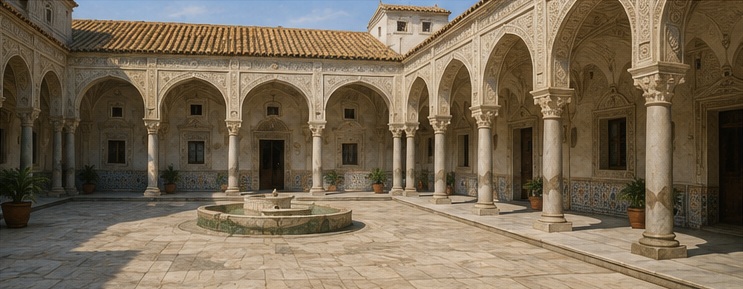
In the lower Casbah of Algiers, near the Ketchaoua Mosque and facing Dar Aziza, stands a palace whose name has never changed: Dar Hassan Pacha. Begun in the year of his accession, it remains one of the most tangible memorials of Hassan III Pacha’s brief reign.
Architecture, like diplomacy and government, formed part of the visible expression of the Regency’s authority.
Construction and Original Purpose
The palace was commissioned by Hassan in 1791, either while he still held the office of Khaznadji or immediately after becoming Dey. It was designed as a private residence suitable for a high official and, later, for a ruler. Formal audiences could also be held there, although the full Divan usually met at the Jenina.
Its location in the lower Casbah placed it close to the centres of power while remaining slightly removed from the damp and exposed waterfront.
Architecture of the Palace
Dar Hassan Pacha followed the traditional plan of large Algerian houses. Rooms were organised around a central courtyard (wast ad-dar). Entrance vestibules (skifat), reception halls, private apartments, and terraces completed the arrangement.
The interiors were enriched with tiled surfaces, including imported Delft ware, carved woodwork, and the characteristic arches of Algiers. The building rose several storeys and was crowned by a terrace offering views over the city.
In its original form the palace expressed the refined domestic architecture of the late Regency.
Later Transformations
After the French conquest of 1830 the palace became the winter residence of the Governors-General of Algeria. In 1839 it underwent substantial remodelling. A new European-style façade with large windows and balconies was added, altering its external appearance while much of the internal structure survived.
In subsequent decades it served various official purposes, including institutions devoted to Islamic studies and, later, the Ministry of Religious Affairs. It has been classified as a historic monument and forms part of the Casbah of Algiers, a UNESCO World Heritage site.
Memory and Continuity
Before 1830 the palace passed through Hassan’s family. It was associated with his daughter Fatma and later with members of the household of Hussein Dey. Despite successive changes of regime and architectural alteration, the building has retained the name of the Dey who ordered its construction.
In a city that has known many rulers, the continued use of the name Dar Hassan Pacha is itself a form of historical memory.
A Lasting Mark
Hassan III Pacha’s reign lasted less than seven years. Yet the palace he commissioned still stands in the heart of the Casbah. It is more than an architectural survival. It is physical evidence that the Regency possessed rulers capable of shaping the urban landscape of Algiers in their own name.
Dar Hassan Pacha remains a quiet but enduring witness to the political world of the late eighteenth-century Regency.
Through stone and name, the memory of Hassan Pacha continues to inhabit the city he once governed.
Sources
- Architectural and heritage documentation of the Casbah of Algiers.
- Historical accounts of Dar Hassan Pacha as the winter palace of the French Governors-General.
- Studies of Ottoman-period domestic architecture in Algiers.
- Modern Algerian heritage records and UNESCO documentation of the Casbah.